





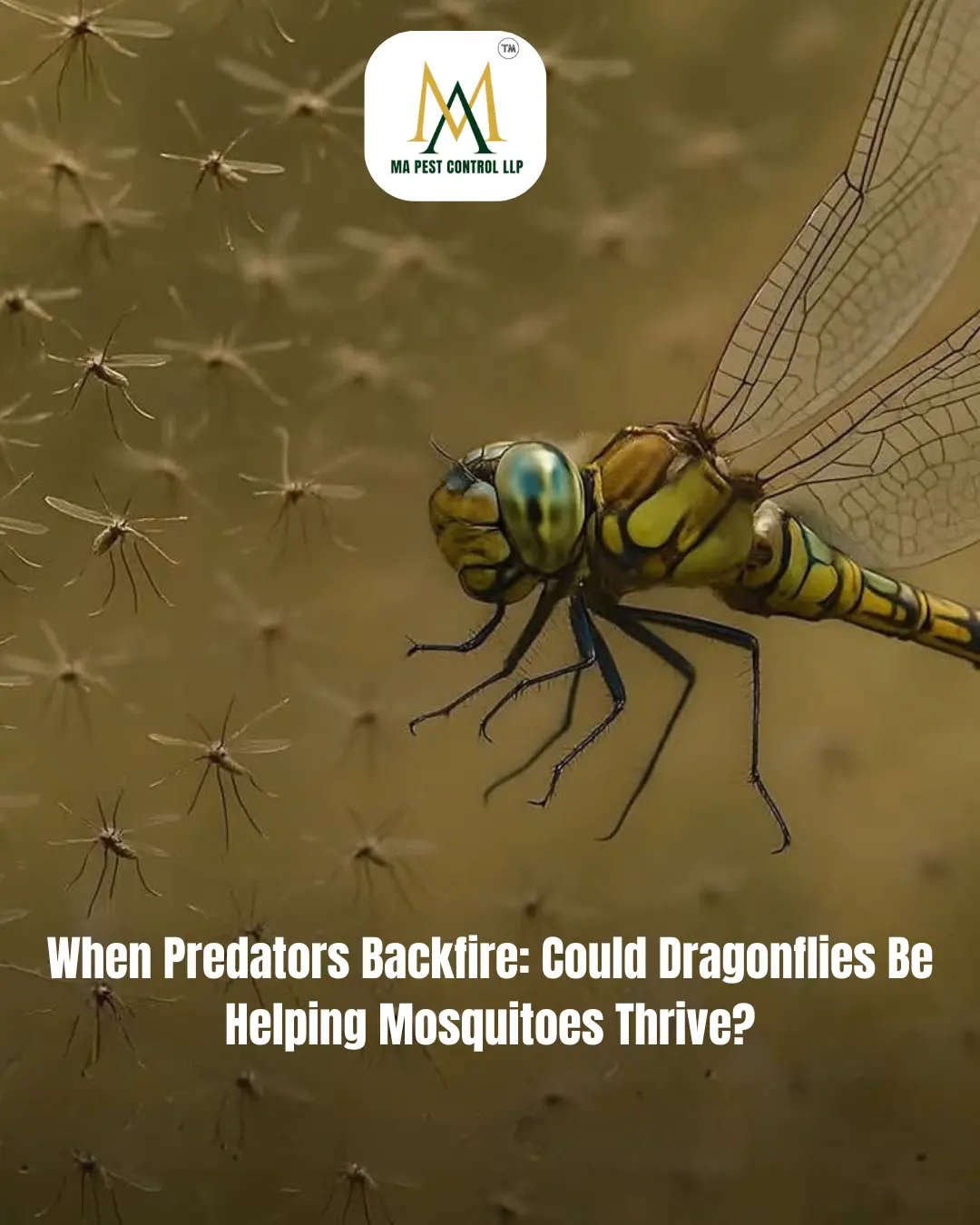
Dragonflies are often portrayed as nature’s little warriors against mosquitoes. Their speed, agility and appetite suggest they could be ideal culprits and more importantly an eco-friendly mosquito control option. However in certain ecological contexts, could it be that dragonflies are helping mosquitoes survive?
It sounds paradoxical—but ecosystem can throw up many contradictions. Lets explore how dragonflies interact with mosquitoes, and why their role as predator is not a simple one to be neatly described.
Dragonflies as Natural Predators of Mosquitoes
Dragonflies are predators in both the life stages examined (see below):
• Adult dragonflies eat small flying insects, including adult Anopheles, Culex, and Dengue mosquitoes.
• Dragonfly nymphs (life stage of dragonfly that lives in water) eat mosquito larvae, and other aquatic organisms.
As mosquito larvae and adult mosquitoes occupy both aquatic and aerial niches, dragonflies appear to be ideal natural enemies and attack at all stages of the mosquito life cycle
The Ecological Twist: When Predator Roles Get Complicated
While dragonflies are good predators; their ability to trap some prey can also create ecological ripples that lead to incentivizing survival for mosquitoes. Here are some possibilities:
1. Non-Selective Foraging
Fish fry and beetle larva are also eaten by dragonfly nymphs in addition to mosquito larva. As dragonflies reduce the density of mosquito enemies (i.e., fish fry, beetle larvae); they are also allowing more mosquito larvae to reach adulthood.
2. Intra-species Competition
When found in anthropogenically produced water bodies (e.g., human-made ponds) dragonfly nymphs may compete at high densities. These conditions may negatively affect the dragonflies predatory performance (i.e., contribution to mosquito larval mortality).
3. Overlap in Habitat Requirements
Both dragonflies and mosquitoes are found in still, clear water bodies. Urban water bodies without top-level predators (e.g., fish, birds, etc.) tend to be breeding environments for both animals. As a result, it is plausible that a weakened predator-prey network may allow dragonflies to become the only opportunity for suppression of mosquito populations.
Misunderstandings in Mosquito Control
Misunderstanding is easy here. Dragonflies aren’t helping mosquitoes, they are following natural behaviour patterns of being a predator. The problem here is the imbalance of ecosystems, tipping the scales to a point due to environmental stressors where dragonflies and other species are unable to keep the mosquito population in check and often largely due to anthropogenic factors such as land clearing/development and improper pest management planning. In steadier ecosystems, dragonflies can be advantageous for controlling mosquitoes. When we try to narrow the role of dragonflies – or when we expect them to make a difference without the rest of the ecological puzzle fitting in place, problems arise.
What This Means for Mosquito Management
Do Not Remove Dragonflies, But Do Not Rely Solely On Them Either
Do Not Remove Dragonflies, But Do Not Rely Solely On Them Either
Dragonflies should remain part of the conversation of natural pest control, but if you wish to address problematic disease vectors like Anopheles, Culex, or Dengue mosquitoes, a more complete strategy is needed.
Embrace Integrated Pest Management (IPM)
Depending on the overall context and importance of mosquito control or management against those previously referenced, a solid integrated pest management (IPM) strategy contemplates:
• Habitat modification: elimination or management of standing water.
• Biological control: introduction of fish that eat mosquito larvae.
• Larvicides: environmentally safe applications specifically available for use on stagnant water bodies.
• Public engagement: awareness and awareness in communities.
Which layered approach may stop a mosquito from carrying malaria, or dengue, all while keeping beneficial species, like dragonflies, from being impacted.
Conclusion: A Lesson in Ecological Nuance
It may sound like a plot twist that dragonfly populations could contribute to the thriving populations of mosquitoes, but it serves as an example of how nature rarely follows any predictable linear path.
Dragonflies are neither the bad guys nor saviors in this conversation. They carry out an important role for mosquito control, but only in the context of a balanced functioning ecosystem.
For us to control our mosquito populations there needs to be an understanding and respect for ecological dynamics. Because in nature, sometimes the heroes need some help.







Leave a Reply
You must be logged in to post a comment.